
Research on Forecasting Behavior
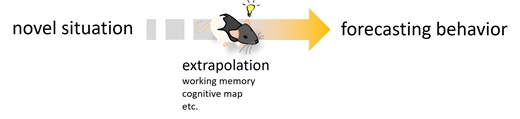
Animals learn goal-directed actions through repeated experiences, but cases without direct experience are also important. If an animal can use cognitive extrapolation based on working memory and cognitive maps to predict and avoid imminent threats, its survival probability would increase. However, research on such forecasting behavior and its neural mechanisms is still lacking.
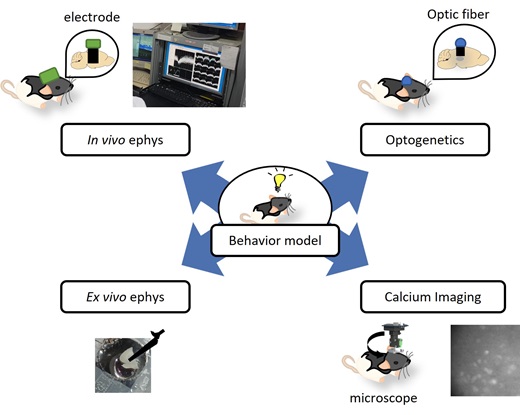
Our lab aims to develop rodent animal models of forecasting behavior and explore the neural mechanisms using invasive physiological techniques. One representative model of ours is the delayed escape task, where a rat experiences a fear-inducing stimulus for the first time, followed by a delay period before it finally escapes.
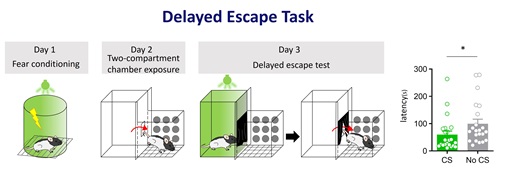
During this delay period, we have measured individual neuron responses and investigated the causal relationship between the delay period and escape behavior using optogenetics and pharmacological methods. We have also utilized calcium imaging and slice physiology methods to gain a deeper understanding of the mechanisms underlying forecasting behavior.
With this series of studies, we wish to broaden the understanding of the mechanisms underlying intentional behavior and even conscious behavior, which are high-level cognitive functions.